
Amazing idea for a website: LinkedIn, but good!
Wasted time
I have wasted a catastrophically large amount of time trying to get GIMP to making a simple text flowchart. 6 hours. SIX HOURS. Trying to draw some arrows and get text to align properly.
Ridiculous.
Pihole no worky
I tried updating my pihole to the latest version. I must have screwed something up, my project won’t start. Kill me now. Ugh.
Updating my status – page
Apparently Atlassian have a statuspage for statuspage. But it looks like it runs on statuspage. So if the status of statuspage is down, does the status of statuspage statuspage update the status of statuspage status?
Maybe they should have a statuspage statuspage statuspage to monitor the status of the statuspage stauspage status.

PowerShell does weird things to a man-
Don’t worry – not an LLM slopper or anything! I had to bulk rename files and modify others.
Still… it’s an exceptionally weird looking commit

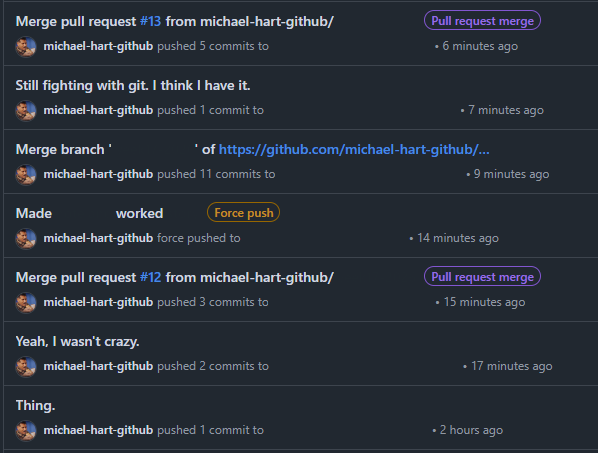
Merge conflicts in a single image
Things Star Trek got wrong
In spite of my love for TNG, it is so clear to me now that the writers had a overly optimistic view of how the Borg would have actually sounded.

What have you been up to?
In the short-term
I’ve been reading through The Complete Developer: Master the Full Stack With TypeScript, React, Next.js, MongoDB, and Docker by Martain Krause. I’ve been taking a bunch of notes on it, and publishing them to my JavaScript GitHub repo.
I’ve also been considering using a site like CodeWars (or possibly CodePen) to try and work on my JavaScript skills. I haven’t really decided yet.
In the longer term
I’ve been working through a bunch of different stuff. There’s a lot of things I’d really like to write on, but it’s been really hard to figure out what my focus should be set to, and where I should be devoting efforts to. Some of the big things I’ve been looking at are this:
- JavaScript
- WordPress themes / PHP
- Contributing to fakerJS repo
- Docker Compose
- Firewall rules
- SSH
- GitHub Actions
- Re-building the WordPress site (this blog) outside of Web Station
To be more precise
- I want to get back into JavaScript for pretty obvious reasons, to myself at least. I want to be able to contribute back to my job a bit better. Postman uses a weird mix of in-house code and basic JavaScript. I’d like to be able to rely less on the Postman-wonk and switch to pure JS stuff. It also looks like the postman wonk uses old versions of stuff (like fakerJS, for example!)Aside from that, I feel like have a stronger knowledge of JS/TS in general will help improve my skill set for WebDev work. I’d like to be able to expand into Frontend/Full Stack work. That can’t/won’t ever happen if I don’t put in the footwork.
- I’ve also been noticing increased malicious bot scans, so I’ve been trying to harden my firewall rules to be more resilient. It hasn’t been too crazy, since this site is essentially non-existent, but if I would ever like to be able to link to reddit, HN, etc. I should have things a bit firmer for the additional issues that will bring over.
- The SemPress theme is fine as getting something basic/tame on the site, but it really isn’t very pleasant to look at, as is. I also don’t like the fact that it hasn’t been updated in a few years; I’d like to make a custom WordPress theme to improve my skills insofar as Frontend is concerned. I don’t mind if it ends up dipping in quality below what it already is; but I’d like for it to be my bad implementation, rather than a strange implementation that is also something that I cannot really update or rely on. (And of course, no disrespect to the maker of SemPress! It’s free, they don’t beg for money, and it doesn’t try to lock me into an ecosystem; that is already better than 99% of the stuff out there! I’m just concerned about whether something might break in a future WP update. I’d like to feel more secure in knowing how to fix it.)To be able to make my own WP Theme, I’m going to need to know PHP, which means more required learning.
- Speaking of, I’d also like to end my dependence on Synology’ “Web Station” for site hosting. It works okay, but I don’t have full control over it. I appear to be forced into a specific version of PHP for some stupid reason. I’d like to rebuild using docker compose, and feel like I have more direct control/say-so over the version of PHP and which DB’s I’m using for it. That kind of stuff. The UI for Web Station isn’t that great either. It kind of functions, but not very well. So, if I don’t have control and the interface is jank…I might as well roll my own via docker.Besides that, Web Station also has serious issues trying to play nice with anything else on the reverse proxy. Web Station assumes that if it’s running, nothing else will ever be on 80/443 ever again. I had turned of a custom script I had built to get Web Station to be nice, and turned it off thinking it was no longer needed – Nope! Still very, very much needed. Ugh. It’s just very clunky and stupid.Even more frustratingly, the logging system that Web Station uses is just so terribly inadequate. I can’t filter and search the way I would expect to be able to. There’s just a lot to be desired. It’s very disappointing.
- I’ve also been doing some stuff on GitHub in terms of building my own dotfile setup,
.gitignore, etc. For./github, I built an action to work with one of the repo’s I’m using during the weekdays, it will auto set the assignee and some other weird values when doing the PR, but I’d like to spread that across all of my projects.That’s also been an issue with Obsidian, too. Each time I build up a new vault (which I probably should stop doing, anyway?) it’s making a new.obsidianfolder, which resets EVERYTHING, so I’ve got a bunch of similar setups with minor differences between them. For some, it would almost make sense, but I want to follow Zettelkasten, so I should probably only have one vault anyway. If that’s the case though, then I need to propagate that across the different repos and kill the bad ones. That also means getting the.gitand.gitignorefiles inline, too, because some were using LF, other CLRF, some were tracking stuff like images, some weren’t. Some were tracking videos, some weren’t. I just need to get them all on the same page on so much different stuff. Ugh. - There’s also been a bunch of social commentary stuff from reddit posts and comments that I’ve been writing down. At the moment I have…55 drafts of things. I don’t want to contribute too much to social sites anymore. I’d rather just do my own thing and try to avoid having LLMs scrape my voice for their own personal profit. I get that eventually they’d probably hit this site too, but I’m hoping that if this ever gets to that kind of level, some kind of web standard to tell LLM scrapers to stop would have become standard and enforced. Perhaps legally, so? I don’t know. Probably wishful thinking, but a man can dream. At the very least, why comment on reddit, or wherever, when I can put that content into my own site, anyway? I doubt the people I’d want to rant at care to read it, and I don’t care to get a bunch of rude comments in return. So, why bother commenting there? Make the post in here, and then link it on there, or whatever.
Struggling with external hard drive
I want to flash my mobo to the most recent version, but in order to ensure the firmware I downloaded isn’t corrupt I need to use Q-Flash. Normally I would just run the checksum against SHA1 or whatever in 7zip, but they only provide me a 4 digit checksum – how stupid is that? Anyway, the checksum will show in Q-Flash.
But in order to use Q-Flash I need to use an external formatted as FAT32, FAT16, or FAT12 (even more stupid!)
In order to do that, I need to use one of my externals, but the only one I could find on hand is one I had formatted to ext4 for fast Windows-to-NAS transfers. I would just format it, but I have a minor backup of some of mine and Kerry’s stuff stored on there. It’s like a 4th or 5th backup, but still, I don’t want to just destroy it all.
It’s being a tremendous pain the butt to get all of this to display in Windows, since NTFS doesn’t want to play nice with ext4, even though WSL is supposed to make it easier – it’s not easier if Windows can’t read it, which is what communicates to WSL is available on the system. ARG!
I managed to figure it out, but I’m going to make a guide because this is stupidly complex for something so simplistic.
Lawn care
I’ve been having a lot of fun repairing the lawn. I’ve designed 5 “zones” for the front and back yard irrigation; dealing with low water pressure has been incredibly aggravating. I’ve also applied a fair amount of organic Milo (Milorganite); it’s organic and only has an NPK of 6-4-0. Synthetic fertilizer (something like 22-0-4) which wouldn’t make much sense right now in early-ish fall, but might be a good idea for late fall for hibernation food.
To make things even more exciting (as exciting as watching grass grow can be), I also bought some Prodiamine to work as a pre-emergent and (minor) form of fertilizer for spring. It’s primary role is to help fight crab grass. I’m interested to see how it works out, but I’ll have to use it in conjunction with some post-emergent “weed killer”. I’ve found some concentrate that isn’t supposed to harm grass but kill weeds. I’m going to start with some spot treatments using some dye, so I can see where I’ve sprayed. Some videos online have also mentioned that adding a small amount of “No tears baby shampoo” to the mix can help due to surfactants in it. Basically, instead of having small individual droplets of weed killer, you get a kind of slick, smooth liquidly surface coverage over the green leaf of the weed. This is good because it’s a more thorough coverage of what the weed needs to live.